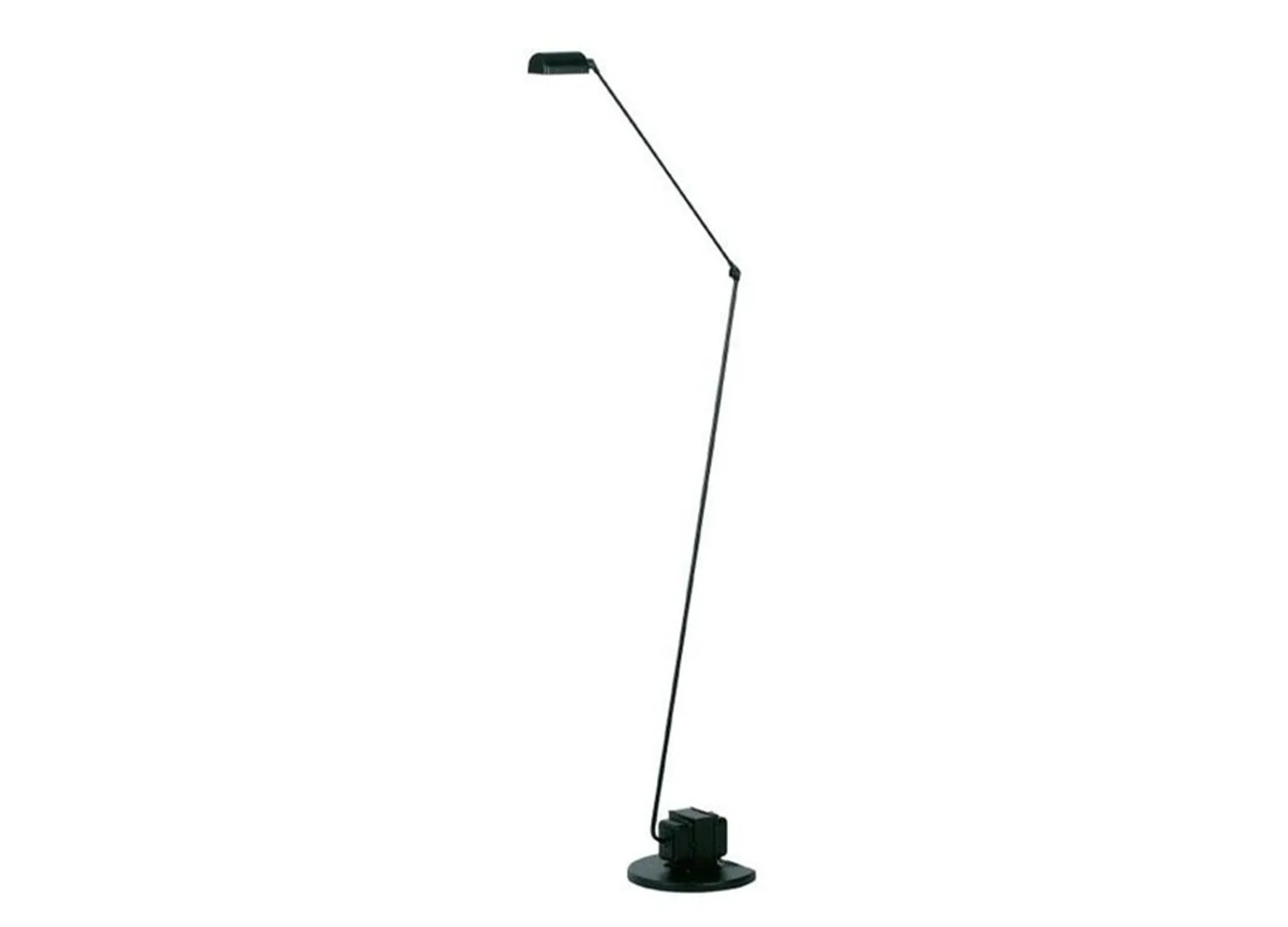
At a time when lighting was fairly bold and colourful, including the use of plastic and chrome, Cimini’s pencil-slim lamp, which morphed into a floor lamp a few years later, must have appeared as a slight oddity. With Cimini’s words to ‘dress the essentials’, the Daphine Terra comprises two fine adjustable arms on a base that are equally delicate and have an adjustable diffuser. Again, his words ‘lots of light, not much lamp’ were beautifully expressed in this lamp, a future classic adored by design buffs worldwide.
Like many creatives who made their mark in lighting, Cimini came from a design background, having studied architecture at the University of Florence before switching to industrial design. However, his experience of working with electromechanical transformers and, later, LED lighting set him apart. His career was always on a lighting trajectory; he took a position with Artemide in 1971 and worked with the eminent designer Ettore Sottsass, one of the founders of the Memphis movement, before later establishing his own lighting company, Lumina, in the mid-1970s.
This allowed him to showcase his own lighting designs, including the Daphine Terra and those designed by well-known designers such as Walter Monici and Riccardo Blumer—known for their ability to express light to maximum effect. In the case of Monici’s lights, such as the Zelig table lamp, there’s a touch of Cimini’s simple and elegant lines—akin to a stalk balancing on one leg. Not surprisingly, the Daphine Terra has found its way into a number of museums worldwide, including the Brooklyn Museum, the Musee des Arts Decoratifs in Paris and the Triennale di Milano.