chevron-down
chevron-up

Inside Lost Profile Gallery by Nickolas Gurtler

Vaulted ceilings in the main space accommodate larger featured works including the brass and glass Atlus Pendant by Oliver Wilcox. 

Lost Profile Gallery’s reverent quality echoes through its sculptural forms and softly conducted light.

Artist, designer and vintage furniture dealer Oliver Wilcox first encountered the ‘profile perdu’ or ‘lost profile’ painting technique while in conversation with a Parisian gallerist—a traditional method in which a turned head obscures the profile, providing only minimal visual cues to convey a distinctive identity. This concept resonates through Nikolas Gurtler’s design of Wilcox’s Lost Profile Gallery. Distinctiveness lies in the unique use of restrained elements: light and shadow conducted throughout sculptural forms.

Gurtler was briefed to design a space intersecting retail and gallery, futureproofed with flexibility for the evolving collection and exhibitions. Naarm-based in Brunswick, the rundown warehouse had “not an inch of exterior spared from graffiti”, Gurtler notes. Inside, vaulted ceilings and west-facing afternoon sunlight held potential.

Four gallery spaces meander like a series of portals, introducing a sense of compression and release. From a voluminous central space, visitors enter two more enclosed rooms with blue-painted brickwork showcasing lighting and vintage furniture, before emerging into an L-shaped gallery wall that hugs the perimeter.

The light, expansive main space is finished in a custom limewash paint that provides a brushed warmth.

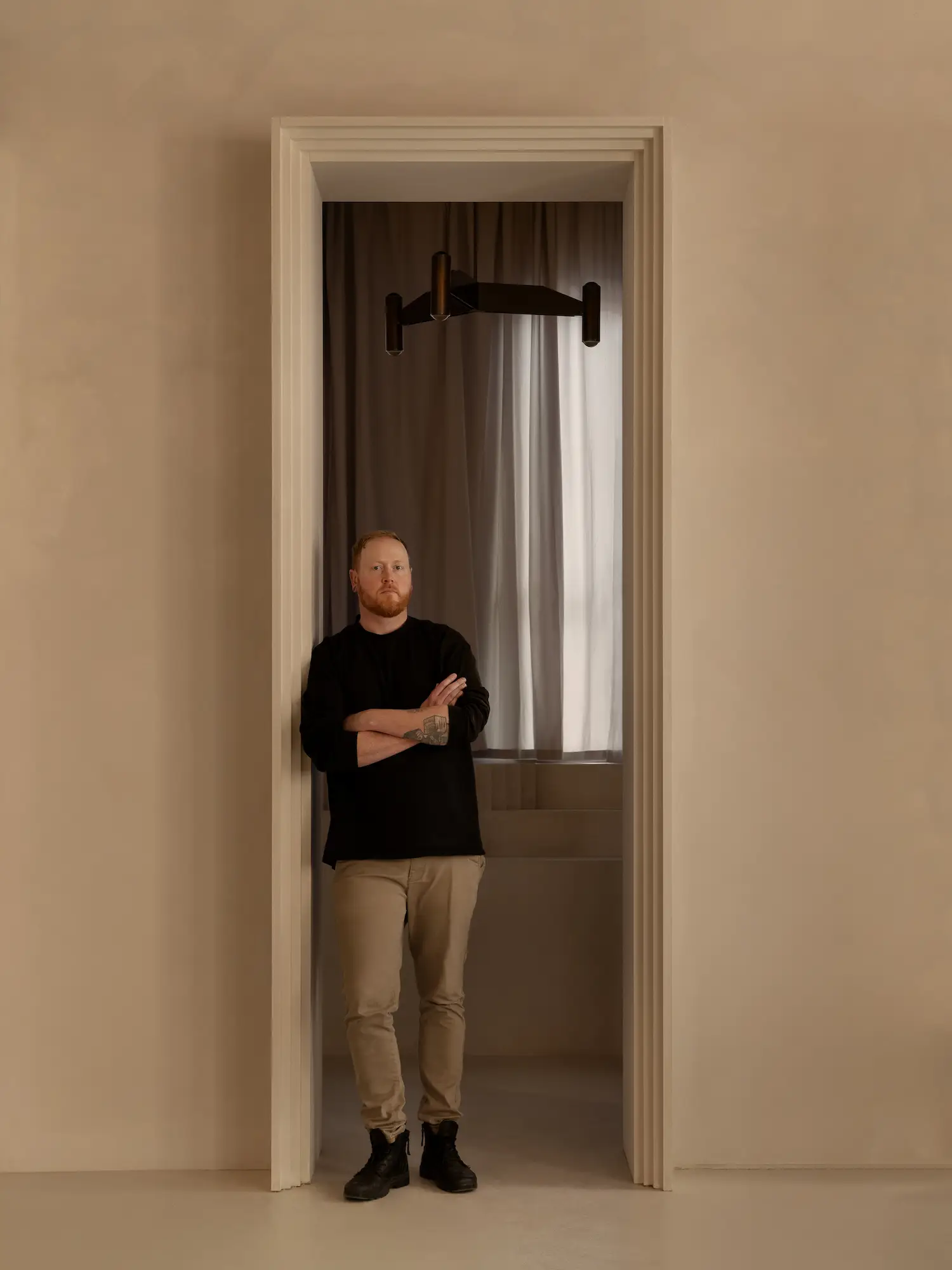
Lost Profile Studio founder Oliver Wilcox

Interior surfaces are glazed in a creamy, custom-mixed limewash paint that contributes a reverent, sculptural tone, intertwining products with the carved shapes of the interior design. Influenced by Carlos Sacapa’s Tomba Brion, Gurtler explains, “I’ve always felt there was an art-like, sculptural quality to Lost Profile products. We wanted visitors to stop and study each piece like they would in a museum. Form in unified colour stories, volume and manipulated light allows the design to not distract, but to focus attention.”

The heart of the gallery features a ziggurat-style desk with its etched steps a recurring cadence across narrow shelving that lines the gallery wall. The darker blue, “dusk” space complements softly glinting lighting designs inspired by tortoise shells and antique candle reflectors, where the bulb is oriented back towards the shell, the light diffused bouncing off the tactile brass. The design process ensured each piece of this curated collection would fit like puzzle pieces with a custom place. Gurtler discusses, “We modelled each collection piece into our 3D concepts, ensuring we created opportunities for display that weren’t haphazard.”

This responsive outcome, with a restrained marble-like palette that moulds itself around products as a holistic form makes the space as intriguing and immersive as the objects it houses. As one visitor aptly expressed, “being in this space is like gazing into a Rothko.”

Along the gallery perimeter, curated vintage finds are displayed alongside new designs and in some cases are proximate to the nature-based references that inspired them, such as vertebrae-like bones.

The lighter blue ‘dawn’ room is more home-like featuring a Covenant pendant of white glass and brass by Oliver Wilcox above a timber dining table.

Brass, bronze and aluminium materiality from the Caraspace collection by Oliver Wilcox, inspired by tortoise-shell forms, glimmer in the darkness of the deep indigo “dusk” space.

Sculptural doorframes and narrow oblong internal windows, between the gallery wall and the central space, frame Wilcox’s designs and as Gurtler highlights, “provide calibrated sightlines”.

est Recommends

The Faces Shaping Australian Interior Design

Leave a Reply

Your email address will not be published. Required fields are marked *