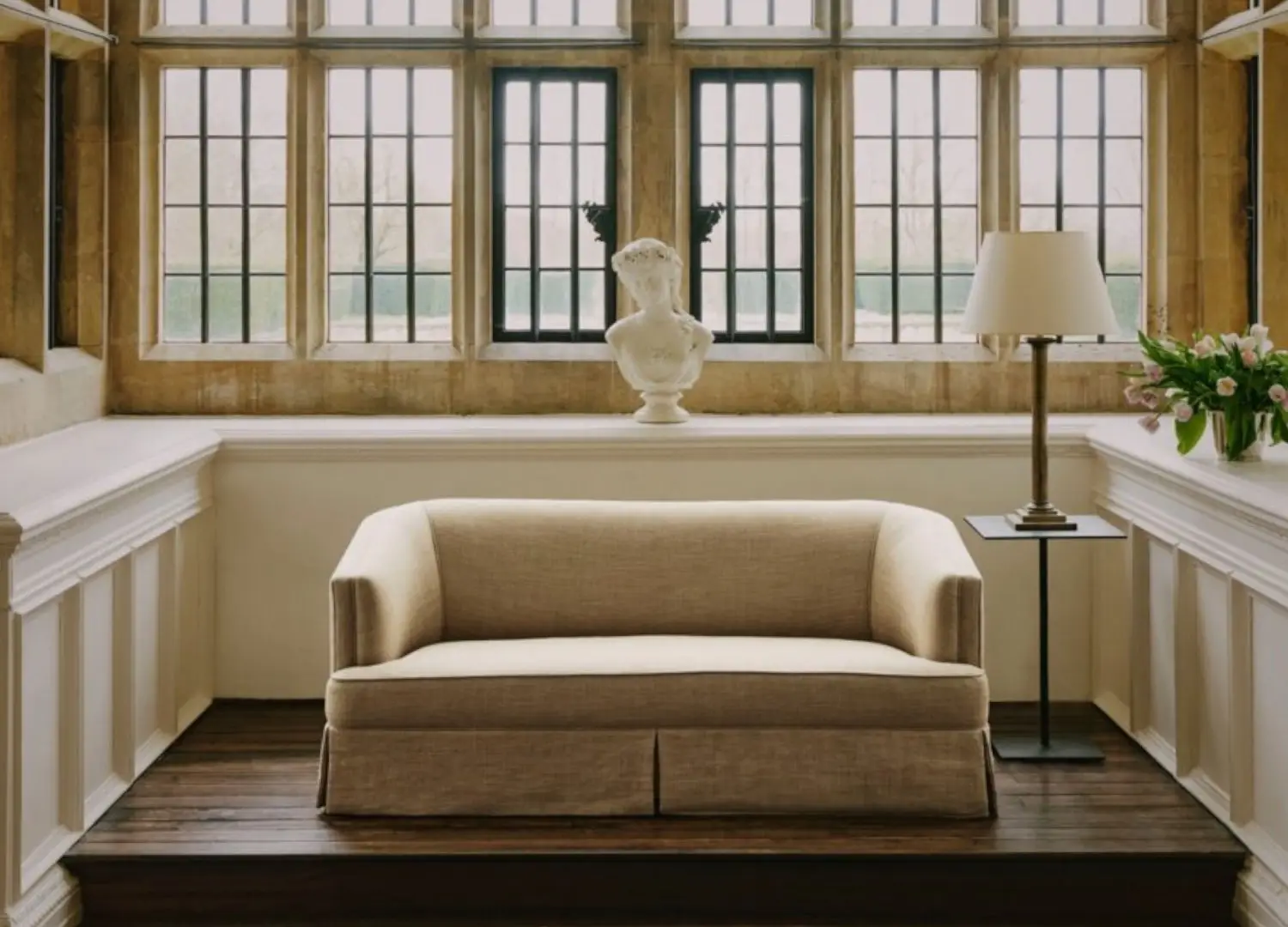
Mayfair Apartment by De Rosee Sa | Photography by Kensington Leverne
Editor Sophie Lewis sits down with husband-and-wife architects and De Rosee Sa co-founders Max de Rosée and Claire Sá in their London studio. As the Notting Hill-based practice approaches two decades of design, the pair reflect on expanding from architecture into interiors, the need to contrast materials at all times, and why their attention to detail doesn’t stop at the ceiling.
In conversation, the architects also discuss the inspiration behind De Rosee Sa’s first furniture collection, opening their Lisbon studio, and the experience of designing their first hotel project.
Having both met while studying, was it always an ambition to start a practice together?
Max de Rosée: No it wasn’t. We didn’t meet and immediately think, let’s start a practice together. Life just took hold. We’re married, and we have children; none of that was planned in relation to starting a studio. I’ve always enjoyed the idea of independence. I’d worked in smaller practices and felt something was missing, that it wasn’t quite satisfying. I was keen to start something of our own, though Claire wasn’t necessarily at that point—she’d had a very successful career elsewhere.
Claire Sá: There was never a big master plan. If someone had told me I’d marry someone and work with them, I would have thought that was a terrible idea. It just evolved. Max changed practices, I left mine, then I got pregnant. While on maternity leave, I picked up a small project that Max had been working on, then another followed. It slowly morphed into me doing a bit on the side, and eventually, it felt obvious that we should start on our own studio. It was very organic rather than premeditated.

De Rosee Sa founders and architects Max de Rosée and Claire Sá | Photography by Kensington Leverne

Mayfair Apartment by De Rosee Sa | Photography by Kensington Leverne

Mayfair Apartment by De Rosee Sa | Photography by Kensington Leverne
You first established yourselves as a high-end residential architecture practice before expanding into interiors. How does that architectural foundation shape the way you approach interior projects today?
Claire Sá: Architectural training in the UK is very rigorous. We both studied at Edinburgh University and then completed postgraduate studies at the Architectural Association, which is famously not a place where you talk about cushions or curtains. At first, I felt a conflict—that focusing on interiors somehow betrayed my architectural foundation. But the more I thought about it, the more I realised that if you’re designing places people inhabit, such as homes, hotels, or even restaurants, if you’re not thinking about comfort, lighting, materials, textures and atmosphere, then you’re not really designing lived-in spaces.
You can always tell when interiors are an afterthought; a kind of lipstick on architecture. We often see buildings where architects simply haven’t thought about how spaces are lived in, which is the fundamental flaw. The more control you have as a designer, the better the outcome. You wouldn’t design a jacket without thinking about the shoes, or stage a catwalk without considering hair or jewellery. Architecture and interiors need to work together.
Max de Rosée: Our interest comes from people. How they live, how they move, where they put their wash bag, where the towel hangs, and how children interact with space. Successful architecture asks those questions. The architecture itself isn’t precious. You let life happen, and that’s often more interesting than the building.

Mayfair Apartment by De Rosee Sa | Photography by Kensington Leverne

Mayfair Apartment by De Rosee Sa | Photography by Kensington Leverne

Mayfair Apartment by De Rosee Sa | Photography by Kensington Leverne

Mayfair Apartment by De Rosee Sa | Photography by Kensington Leverne
In 2020, you opened a studio in Lisbon. While there are clear differences between the projects produced by your London and Lisbon offices, what is the through-line across both? And how do you collaborate across geographies?
Claire Sá: Lisbon is much younger as a studio. Culturally, there’s also been a lag in how architecture and interiors are perceived — architecture is traditionally seen as the “serious” part, while interiors are seen as optional. That’s changing rapidly in Portugal. What we’re trying to bring is an integrated approach where architecture and interior thinking happen together. We’re also very service-driven. We hand-hold our clients and go the extra mile, sometimes two miles, to nurture the relationship and the project.
While the projects differ aesthetically — the buildings, climate, and landscape are different — the philosophy, attention to detail, and client process are the same. Interestingly, most of our Lisbon clients are international: English, Australian, and American. They’re drawn to Portugal but comfortable working in English and with an approach we’ve developed in London.
Max de Rosée: We’re very deliberate about having an approach rather than a style. That allows us to work on a Georgian townhouse in London or a 1970s beach house in Portugal without questioning our identity. We develop a concept early, and that vision informs the project from start to finish. We don’t always know what the outcome will be at the beginning, and that’s important. It keeps the work alive and avoids being trapped by a recognisable look.

Lakeside House by De Rosee Sa | Photography by Lourenço Teixeira de Abreu

Lakeside House by De Rosee Sa | Photography by Lourenço Teixeira de Abreu
You’re currently working on your first hotel project, set within an 18th-century farmhouse overlooking the sea in Sintra. Compared to the intimacy of private residential work, what have you enjoyed most about designing every aspect of this hotel?
Claire Sá: Although it’s a hotel, the scale is still intimate. The farmhouse is composed of several modest buildings rather than a single large block, so it feels more like designing multiple houses than a conventional hotel with long corridors and repetition. The concept was always to make guests feel as though they’re arriving at someone’s home, not a grand, formal hotel. You enter through an old gate, and that sets the tone for how history is woven into the experience.
What’s been enjoyable is designing for people we don’t know. With private clients, you understand their habits and preferences. With a hotel, you project what you would want — how you’d like the spa to feel, how the garden should work. It’s indulgent and scary at the same time.
Max de Rosée: It’s also liberating. In residential projects, you often need to pull back to reassure clients. With the hotel, we’ve been able to fully commit to colour, pattern, layering without that brake. We’ve also been able to control everything: music, scent, how staff move through spaces, gardens, and pools. It’s a holistic exercise, and that level of control really reinforces the atmosphere.
Your material signatures include lacquer, solid timber, expressive natural stone and limewash paint. What role do these materials play in shaping the experience of your projects?
Claire Sá: It’s about contrast. If everything is timber, you stop seeing the timber. Materials need to be offset: something shiny against something raw, something hard against something soft. That tension creates interest and allows spaces to age well. It also means you can introduce an antique next to a contemporary artwork, or live comfortably with children and everyday life without the space feeling fragile.
We also think about every surface, including ceilings. They don’t have to be white plasterboard. When you visit old buildings in Paris or Rome, ceilings are often just as important as floors. Being adventurous is part of dressing the whole interior.

Lakeside House by De Rosee Sa | Photography by Lourenço Teixeira de Abreu

Cornwall Retreat by De Rosee Sa | Photography by Peter Molloy

Cornwall Retreat by De Rosee Sa | Photography by Peter Molloy
Drawing on custom designs in past projects, your own furniture collection is now available. How do these pieces respond to gaps in the market?
Max de Rosée: The pieces usually come from projects. We don’t design furniture in isolation. We reach a point where we can’t find the right table or chair, so we create it—and sometimes realise it has a life beyond that project. We’re conscious that commissioning an architect or interior designer is exclusive. Furniture allows us to offer something more accessible; objects that bring joy without requiring a full commission.
Earlier this year, you rebranded and launched a new website. How does this milestone reflect the studio today, particularly the idea of “Beauty through Affinity”?
Max de Rosée: The rebrand came from reflecting on where we want to go over the next decade. We’re no longer just architects; we want to project ourselves as holistic architects and designers, and for the brand to demonstrate that shift. “Beauty through Affinity” speaks to listening. Good design comes from understanding people, how they live and responding sensitively to place, material and context, rather than imposing a predetermined style.
Claire Sá: Colour was a big part of that conversation, and there’s a parallel between how we use colour in projects and how it appears in the rebrand. Earlier in the practice, our work, and by extension our presentation, used far less colour. Over time, we’ve become more confident in using colour to create warmth, emotion and depth.
Rebranding is always exposing. You’re capturing a moment in time and hoping it will last. We worked with designers who intuitively understood us and translated our values. Affinity is about people, but also the materials, the landscape, the culture.
As you near two decades of practice, what’s one learning you wish you’d known at the beginning?
Max de Rosée: You have to stand up for your values. Early on, you take whatever comes, as you just want the work. Over time, you find the space you want to occupy, and you realise you need to fight to protect it.
Claire Sá: You need optimism and a bit of naivety. If you truly knew how hard it would be, you might never start. You lean into it, learn as you go, and hope that with time, you get a little better at what you do.

Cornwall Retreat by De Rosee Sa | Photography by Peter Molloy

Cornwall Retreat by De Rosee Sa | Photography by Peter Molloy