Marcel Wanders brought his magical Dutch sensibility to the design world when he established his practice Moooi in 2001. He was already on the world’s design radar when he released his masterful ‘Knotted Chair’ five years earlier, a macrame-like seat that is as much art as it is furniture.
When it comes to lighting, Wander’s name is attached to so many lights that have completely transformed the way we see lights today – from his ‘Smoke Chandelier’, with its structure partially burnt through to Moooi’s Raimond II R43 pendant light, which resembles fireworks on a New Year’s Eve. And of course, who can forget the Perch light, where illuminated birds are delicately perched on brass rods. In 2011, the New York Times described Marcel Wanders as the ‘Lady Gaga of the Design World’, acknowledging his unconventional, creative and unlimited energy.
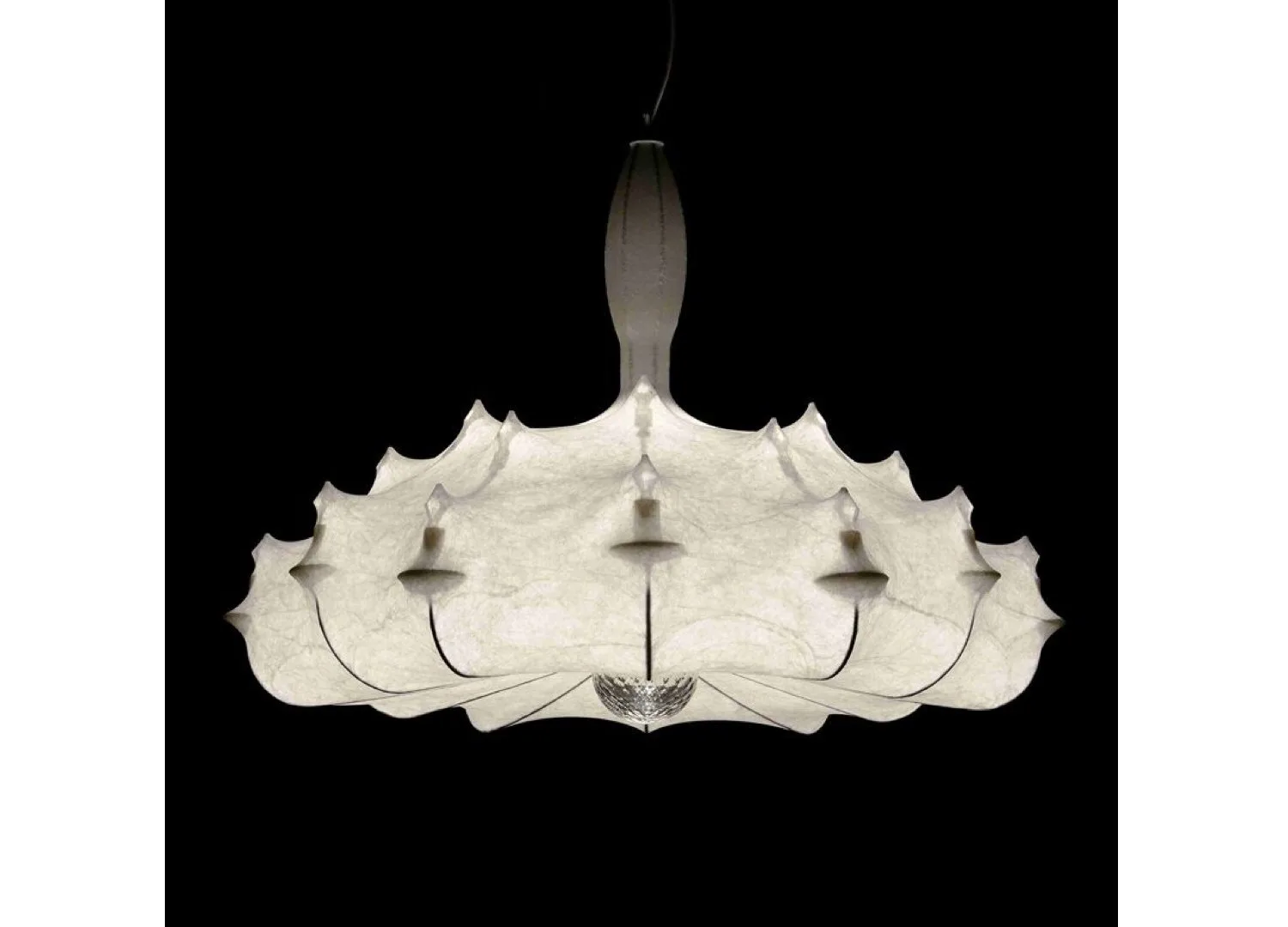
The Zeppelin 1, a pendant light that was released by Flos in 2005, is evocative of the past; with Wanders drawing inspiration from a pendant designed by Achille and Pier Castiglioni in 1960.

The Zeppelin 1 pendant, designed by Marcel Wanders for Flos.

Avenue Marceau Apartment by Hélène Van Marcke | Photography by Thomas De Bruyne

Avenue Marceau Apartment by Hélène Van Marcke | Photography by Thomas De Bruyn
As with this pendant light, where the bulb is ‘veiled’ in a translucent fabric, the Zeppelin 1, designed for Flos, is sheathed in a resin spray that loosely resembles cobwebs. A chandelier with translucent light bulbs that resemble candles adds to the light’s mystery and charm with a whimsical touch that appears in all of Moooi’s designs – whether they take the form of furniture, carpets or complete interiors. The crystal form, nestled within the base of the light also creates that added sparkle and magic to a space – be it found in a living area, a dining room, a bedroom, or even in an entrance or a lobby. While Wanders, as with other designers, has used the Zeppelin 1 in both domestic and commercial settings, he particularly likes to use this design hovering above a dining table. As mentioned in one of his interviews, “…having the light above a table creates a ‘symbol of unity in bringing people together”. He was also quoted as saying that the importance of a design is to be able to make it as “naked as possible”, revealing its structure.

Spring Street by March Studio | Photography by Dan Preston
The Zeppelin 1, as with many of Wanders’ other lights, has this sense of ‘nakedness’ while still allowing for the chandelier to be appreciated. Interior designer Lucy Marczyk has used the Zepplin 1 in a number of projects. She also had it in the living area of her former home, simply attached from a ceiling hook rather than having it firmly secured to the ceiling. “I knew I would be moving, so I wanted to take the light with me,” Lucy says, who saw her approach as being a bit Scandinavian. “In countries such as Scandinavia, people not only take their lights but, in many cases, also their kitchens when they move,” Lucy says.
Lucy sees the Zeppelin 1 as akin to attending a ‘dress-up party’ when the occasion calls for a bit of ‘glam’ and fun. “When you go to a dress-up party, it’s about transforming yourself into another person or character,” Lucy says, who, as with Wanders, sees the Zeppelin as being well suited above a dining table. However, she also enjoys seeing it in an entrance or a lobby and feeling the pleasure, as well as the element of surprise, upon arrival. “If you have the right ceiling height at the entrance, the Zeppelin is perfect, a sense of welcoming and intrigue before you enter the living areas,” Lucy says.
While the Zeppelin 1 is a future classic, the same could be said for many other lights designed by Marcel Wanders – with many of his lights setting up a ‘dialogue’ between the past and the present, imbued with memories that elevate design several notches.