

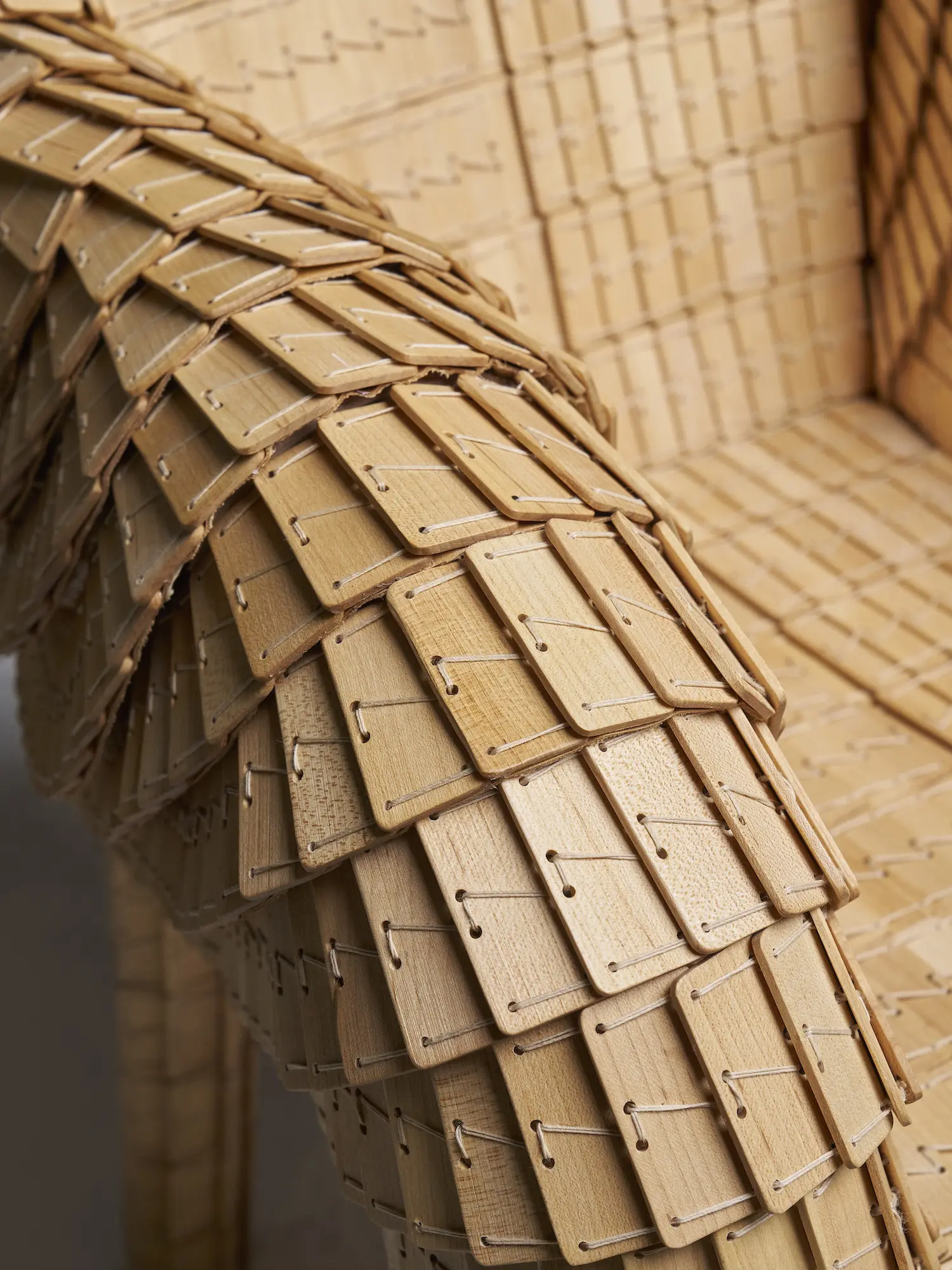
Richards Stanisich, with Meg Ashforth, designed the Lamella chair in maple, referencing the layered construction of Japanese armour through a surface of hand-sewn timber tiles.
Following its debut in Sydney last year, KEEP: Forever Objects comes to Melbourne Design Week, asking the question: what makes an object worth keeping?
What does it mean to design for longevity in a disposable age? KEEP: Forever Objects responds by asking six Australian architectural practices to work with American hardwood and consider what makes an object worth holding onto.
Presented by the American Hardwood Export Council (AHEC) in partnership with Cult Design, and curated by David Clark, each studio was tasked with developing a furniture piece or object using American hardwoods, examining the material not only aesthetically but through the lens of sustainability, resource use and long-term relevance.
For Cult founder and managing director Richard Munao, the project signals a shift in how design is being understood. “An initiative like KEEP reflects a broader cultural shift in design thinking,” he says. “There’s a growing emphasis on stewardship over disposability—on creating pieces that are considered, responsibly made and designed to last. It speaks to a future where materials are valued more deeply, and where design is measured not just by how something looks, but by how long it endures and the story it carries forward.”

Virginia Kerridge drew from traditional woodworking methods, using brass butterfly joints to connect two expressive pieces of American cherry and expose the individuality of the timber grain.

The installation is curated by David Clark; here is is pictured alongside Richards Stanisich and Meg Ashford’s Lamella chair.
Each practice—Kennedy Nolan, Richards Stanisich with Meg Ashforth, Edition Office, Neil Durbach, Virginia Kerridge and Lineburg Wang—developed a furniture piece or object, extending their traditional architectural thinking into smaller, everyday forms. The brief centres on American hardwood, with red oak, cherry and maple selected for their regenerative cycles. “Timber is a sustainable material if carefully managed,” Edition Office director and co-founder Aaron Roberts says. “It’s an incredibly robust material. Its use in design can enable pieces that can last generations, and we hope that experiencing KEEP will continue this discussion around designing for longevity.”
“Working at the furniture scale draws you closer to the material and how to express the integral beauty of the American hardwood,” architect Virginia Kerridge says, who worked with cherry. “The brief was to design a piece of furniture that you could take with you as you move from place to place—something that is precious enough that you grow attached to it.”


LineburgWang designed a tall American Cherry lamp that reveals itself gradually through interaction at both macro and micro scales, incorporating a foot pedal detail that reinterprets a familiar everyday mechanism.
The resulting works span seating, tables, lighting and experimental objects, each piece challenging the notion of disposability. Melbourne-based architecture and interior design firm Kennedy Nolan’s David console, for example, is crafted in American cherry, selected for its tonal depth and distinctive red hue. “All the timbers had appealing characteristics, but we chose cherry because we loved the unique colour, which is quite distinct from other red-hued timbers,” founding partner Patrick Kennedy says.
He continues: “In Australia, forestry is contentious, and recently, many of our forests have been locked up to protect their fragile ecosystems. The United States has a unique and sustainable approach to forestry, and while Australia sorts out a way to sustainably manage our own forests, American hardwood provides a great alternative for high-quality timbers.”

Kennedy Nolan used American cherry to examine the timber’s tonal depth and surface variation, exploring finishes ranging from rough-sawn texture to a satiny polish that reveals the material’s softer red-brown character.


AHEC builds on this broader conversation around responsible forestry and long-term material use, with the selected American hardwood species sourced from forests where annual growth continues to exceed harvest rates. For more than three decades, the organisation has collaborated with the international design industry to advocate for the environmental performance and longevity of American hardwoods, a position reflected in KEEP.
The installation will be presented at Cult Design’s Melbourne showroom, offering a rare opportunity to see the six architectural practices working beyond their traditional discipline, through the scale of objects rather than buildings. Visitors are encouraged to slow down, look closely and contemplate the value of the objects they keep.
KEEP: Forever Objects will be presented at Melbourne Design Week 2026 from Thursday, 14th to Saturday, 23rd May, and continue until 8th June. See more information here.

Edition Office focused on the relationship between body and object, creating a seating system that amplifies the direction of the timber grain while considering how material is touched, held and experienced over time.

Neil Durbach worked with oak to create a table and objects intended to weather through use, pairing raw timber surfaces with reflective interiors—shaping pieces designed to move with their owner over time.