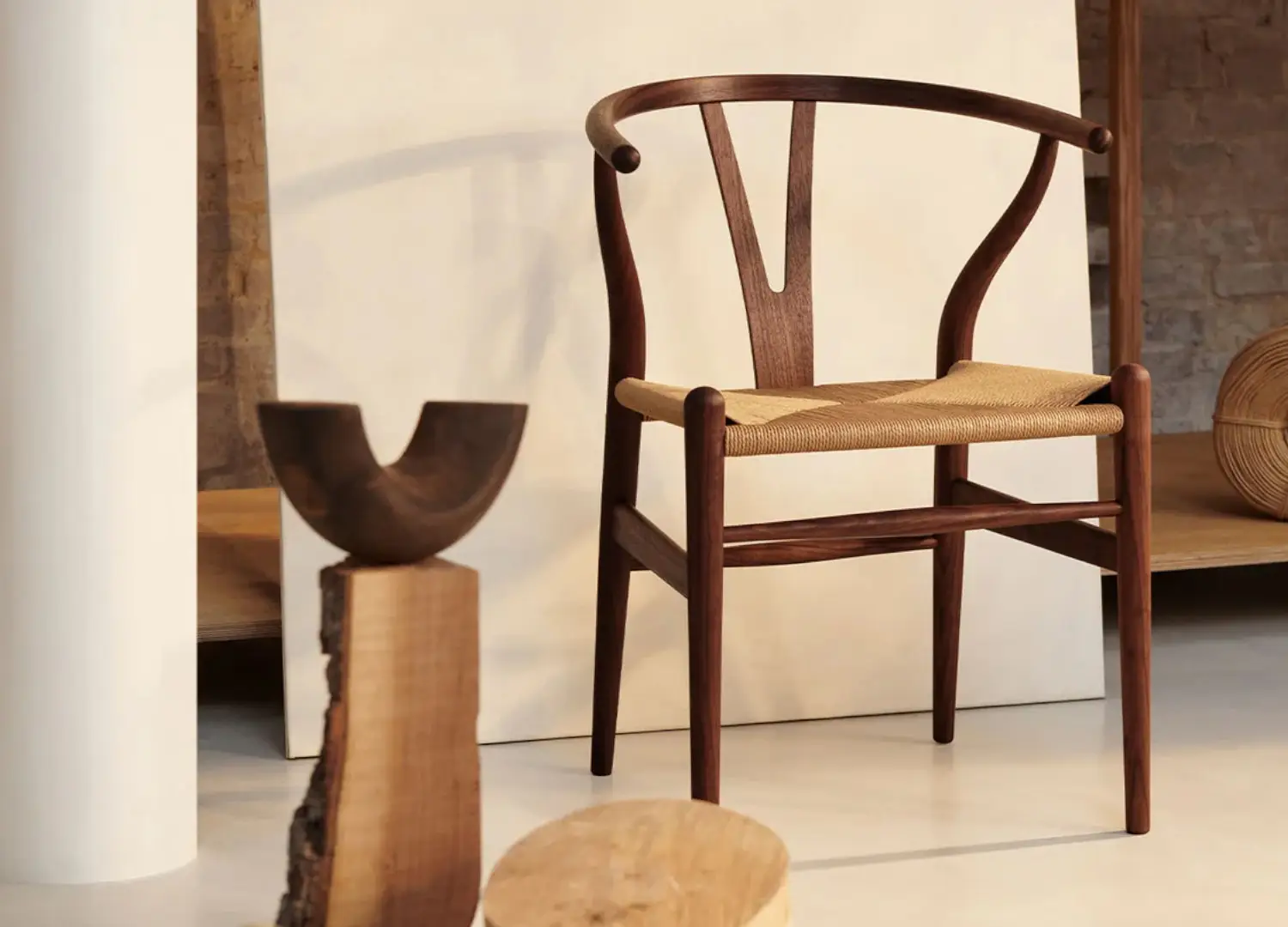
The CH24 Wishbone chairs by Hans J. Wegner, accompanied by a rare pendant light of his design—one of only three ever made.
est editor Sophie Lewis recalls her visit to the Danish island of Funen, where she entered the hallowed halls of Hellerup Manor to learn more about Carl Hansen & Søn’s enduring family legacy, and the making of an icon: the CH24 Wishbone chair.
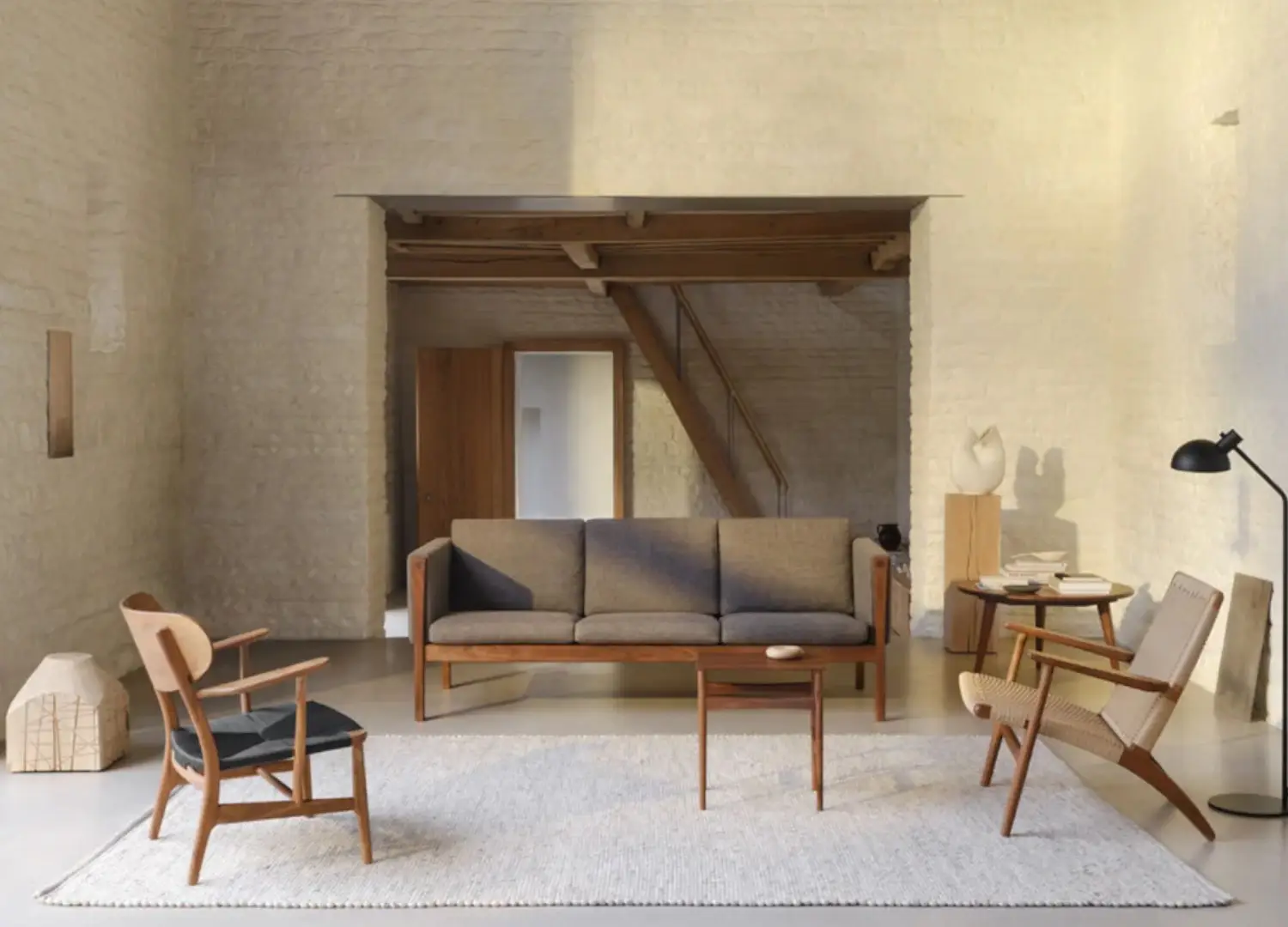
Known for producing some of the most internationally appreciated Danish furniture today, Carl Hansen & Søn was founded in 1908 by cabinetmaker Carl Hansen. With a through-thread of uncompromising craftsmanship, Hansen also set out to collaborate with designers, most notably Danish designer Hans J. Wegner, from the beginning of his career. As the largest manufacturer of Hans J. Wegner’s pieces, the designs are at the heart of the brand’s DNA and are synonymous with the Danish modern movement.
One such piece is the CH24 Wishbone chair, and it was the making of this chair that brought est editor Sophie Lewis to Funen to see how it has retained lasting relevance. Here, she was welcomed to Hellerup Manor, the private residence of Carl Hansen & Søn CEO and third-generation owner Knud Erik Hansen, his wife, Dr. PhD director CCO Carl Hansen & Søn Retail Inger Hansen, and their German Shepherd, Pauli.
Knud Erik Hansen took over the reins in 2002, growing Carl Hansen & Søn internationally and its employees from 45 to 500, who are predominantly based in Denmark. Over afternoon tea in the manor’s garden, Hansen reflected on staying true to the high-calibre materials and craftsmanship through this expansion, and working with contemporary designers who sing to the same Danish modern songsheet, such as Rikke Frost, Gudmundur Ludvik, Mads Odgård, Anker Bak, Thomas Bo Kastholm and Morten Gøttler.


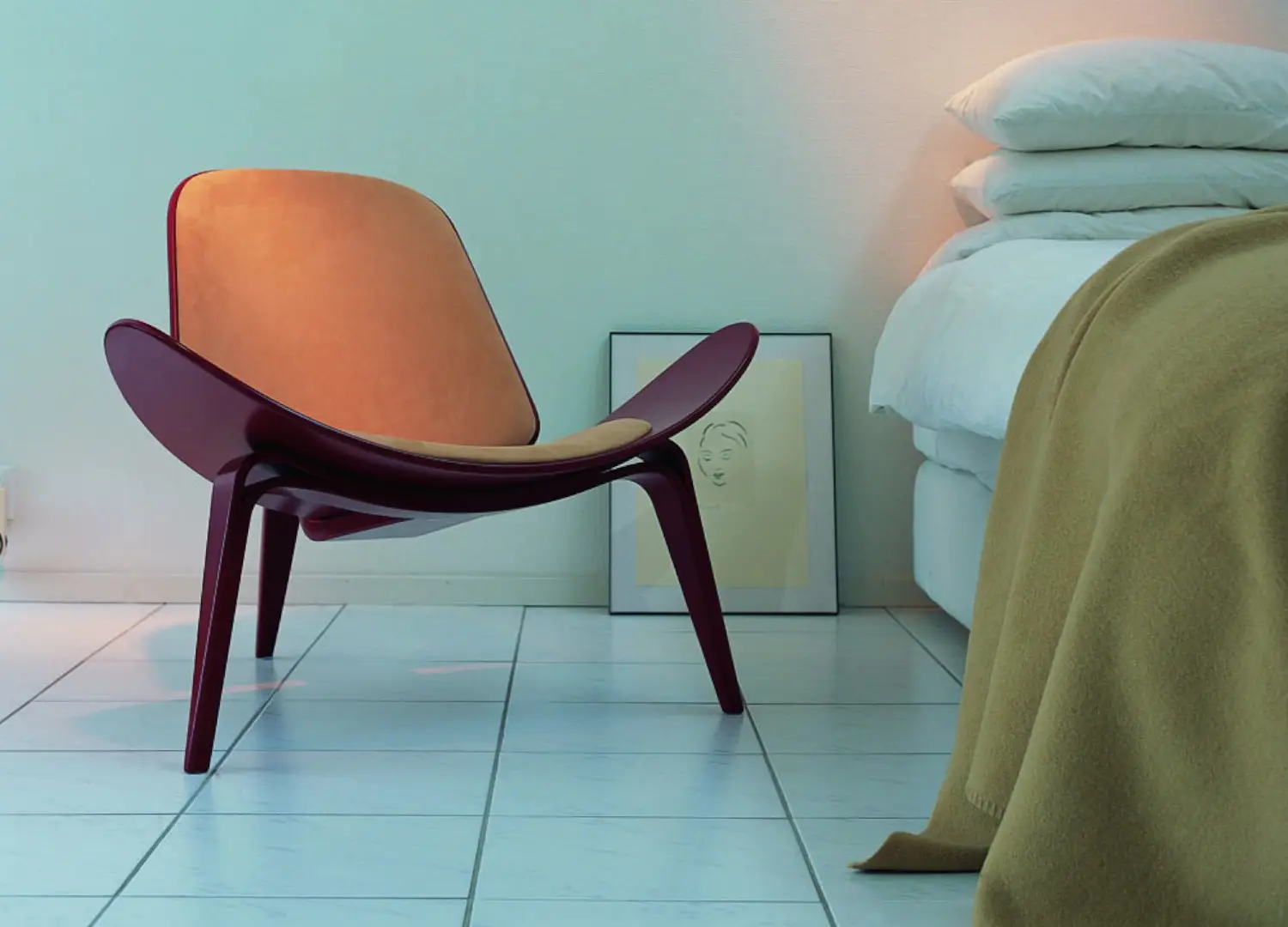
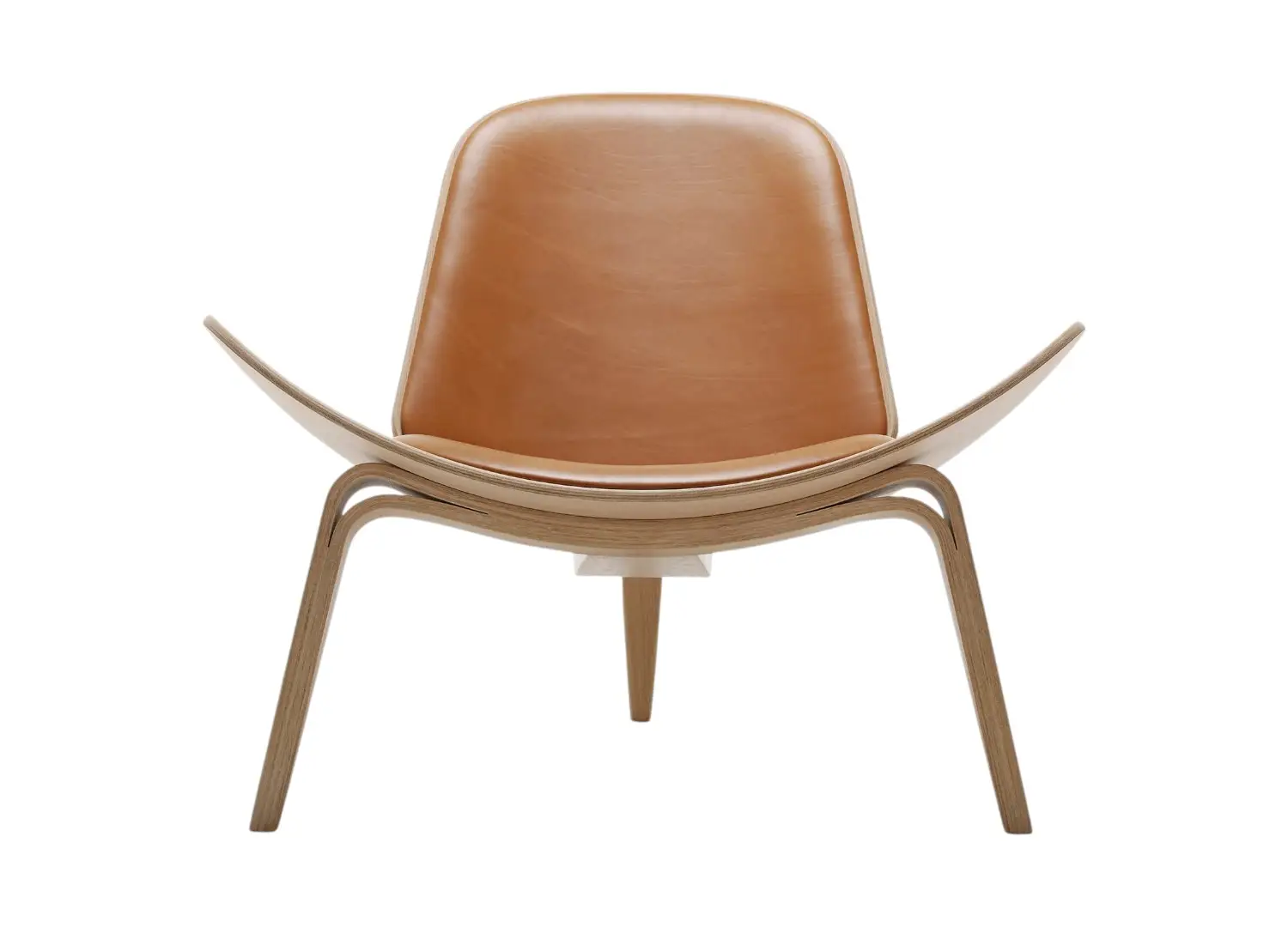
Carl Hansen & Søn CH07 Shell easy chair and the Carl Hansen & Søn CH47 chair, both by Hans J. Wegner.


The alfresco afternoon was also to celebrate the brand’s latest international collaboration with Austrian design studio EOOS on the Embrace outdoor lounge series. Two of EOOS’ founders, Gernot Bohmann and Martin Bergmann, presented the new series, observing the brand’s core design values in a present-day context.
A tour through the neoclassical Hellerup Manor with Knud Erik Hansen followed, recounting the ambitious renovation project that began nearly twenty-five years ago. The manor dates back to 1670, with several iterations made in the century following. Meanwhile, the adjacent church was built in 1200 and still retains its original Roman foundation.


Moving through some of the manor’s spaces, wrapped in rich red, green and ochre tones, Hansen told the personal stories behind his collection, including prototypes from when his late father Holger Hansen worked closely with Hans J. Wegner. In the formal dining room, Hansen spoke to the Hans J. Wegner pendant lamp, originating from his childhood summer home. As one of just three to ever be produced, Hansen made it his mission to find all three, which are featured on each level. His revered collection also includes furniture by Ole Wanscher, Mogens Koch, Kaare Klint, Poul Kjærholm and Frits Henningsen, some of which have been passed through the three generations.
The next morning, the press stepped inside the factory to see the master craftspeople at work on the CH24 Wishbone chair, and to try their hand at both sanding and weaving. First passing through THE LAB, they saw the apprentice workshop where Carl Hansen & Søn train the next generation of cabinetmakers.
As a smaller cabinetmaker workshop, THE LAB is responsible for not only cabinetmaking, but commission orders, restoration and repairs, further extending the life of the furniture. An initiative established to preserve the precise artisanal skills behind creating each piece, THE LAB emphasises that no machine can replace the human hand and eye. It was an ethos Wegner stood by, known for designing by being in the workshop.
The CH24 Wishbone chair was Wegner’s first collaboration with Carl Hansen & Søn, and has remained in production for the past 75 years. Known for its Y-shaped back, which earned it its name, the timber chair was designed for series production— a concept that was not typical of the time—with top rails and arms as a single piece. The seat features 150 metres of paper cord, and takes the most experienced weavers an average of 45 minutes to an hour to weave. Here, machines do the heavy work, but every CH24 Wishbone chair must be sanded, glued together, coated and woven by hand.
Back in Copenhagen, the tour was capped off with a walk through Carl Hansen & Søn’s new flagship showroom. Unfolding across three levels, including a roof terrace, the brand presented Framing Compositions, with Hans J. Wegner’s CH290 series, Nanna and Jørgen Ditzel’s Vita sofa and coffee table, and the return of Hans J. Wegner’s CH621 Swivel chair, marking the occasion. Wegner may have designed 500 chairs in his time, but only very few swivel chairs. Entering production again after 75 years, the rerelease of the CH621 Swivel chair attests to Carl Hansen & Søn’s dedication to preserving its archive, and the time-honoured processes that make each piece an heirloom.

Each CH24 Wishbone chair seat is hand-woven with 150 metres of paper cord, a process that takes even the most skilled weavers up to an hour to complete.

Hans J. Wegner’s first collaboration with Carl Hansen & Søn, the CH24 Wishbone chair has been in continuous production for 75 years.


Carl Hansen & Søn CEO and third-generation owner Knud Erik Hansen, his wife, Dr. PhD director CCO Carl Hansen & Søn Retail Inger Hansen, and their German Shepherd, Pauli at Hellerup Manor.